

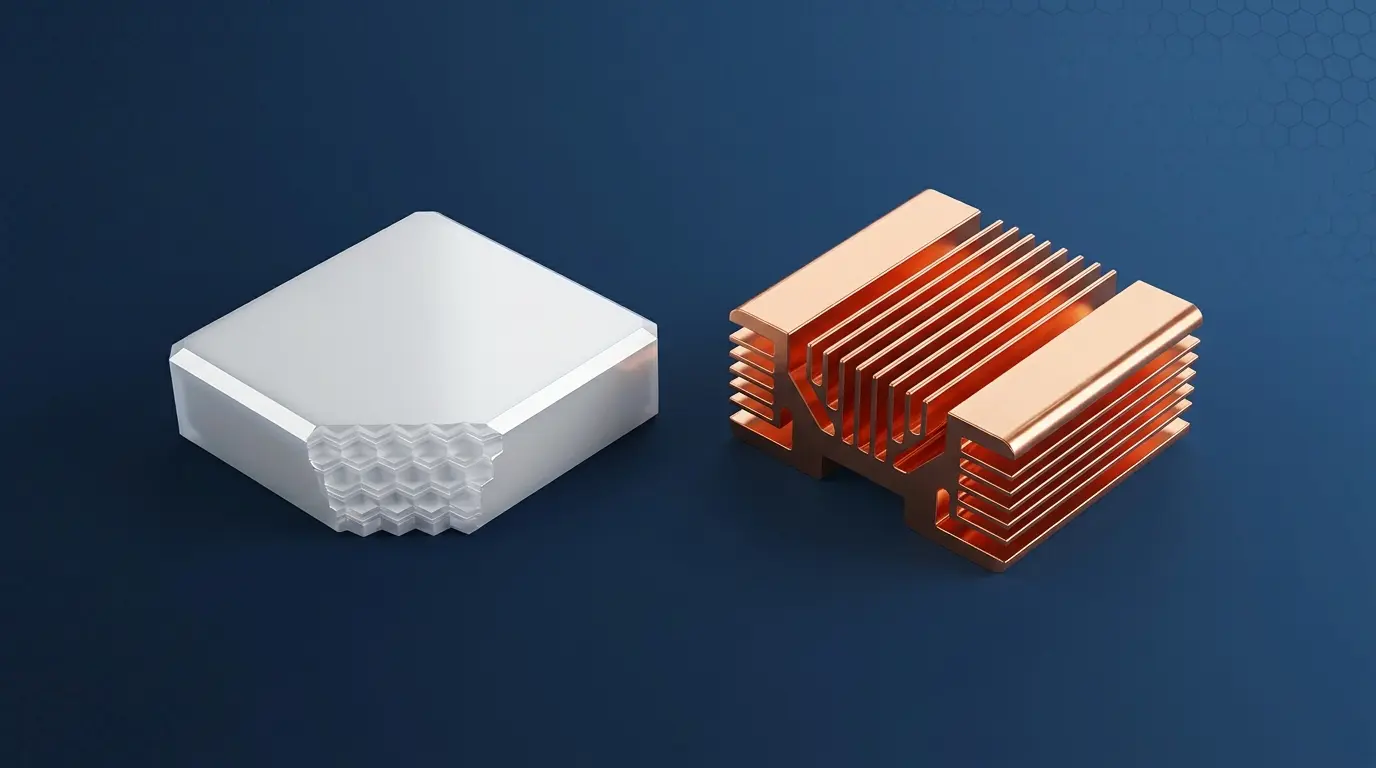
When designing advanced thermal management systems, the choice between boron nitride ceramics and copper represents a fundamental trade-off between electrical insulation and the electrical conductivity of pure metals. For a long time, copper has been the industry standard in heat dissipation, with a thermal conductivity as high as 400 W/m·K. However, as power electronics, semiconductor manufacturing, and high-frequency RF systems become increasingly dense, copper’s inherent electrical conductivity (1.68×10⁻⁶ Ω·cm) poses a serious risk of short circuits. This industry-wide challenge has prompted engineers to turn to hexagonal boron nitride (h-BN), often referred to as “white graphene.” While replacing metal with ceramics for heat transfer may seem counterintuitive, boron nitride offers a unique combination of high thermal conductivity (up to 120 W/m·K) and absolute electrical insulation (>10¹⁴ Ω·cm). This comprehensive guide analyzes the key performance metrics, manufacturing processes, and highly specialized machining requirements necessary for the transition from traditional metals to advanced technical ceramics. At Zhihao Ceramics, our engineers are dedicated to bridging this gap by providing precision ceramic machining services with tolerances as tight as ±0.005 mm, replacing complex metal geometries with advanced ceramic solutions.
Material properties
To accurately evaluate boron nitride ceramics and copper for your specific engineering applications, it is essential to understand their potential physical, thermal, and electrical properties. Hexagonal boron nitride employs a covalent sp²-bonded crystal lattice structure similar to that of graphite, allowing for rapid phonon (heat) transfer without free electrons (electricity). In contrast, copper relies on a face-centered cubic (FCC) metallic lattice, in which a large number of delocalized electrons simultaneously carry both thermal and electrical energy. This fundamental difference in microstructure determines each of the macroscopic engineering properties listed in detail below.
| performances | Boron nitride (h-BN) | Copper (Cu – C10100) | unit (of measure) |
|---|---|---|---|
| intensity | February 10–25 | 8.96 | g/cm³ |
| durometer | 20–30 (Shao's S) | 35–45 (HB) | HV / Scale |
| bending strength | 30–40 | 210–250 (tensile strength) | MPa |
| Fracture toughness | 1.0–1.5 | >50.0 | MPa·m² |
| heat conductivity | 60–120 (directional) | 385–400 | W/m·K |
| Resistivity | >10¹⁴ | 1.68 × 10⁻⁶ | Ω-cm |
| Maximum working temperature | 1900 (inert), 900 (air) | 400 (air), 1085 (melting point) | °C |
Density and Weight Reduction: The data shows that h-BN offers significant advantages in aerospace and mobile applications. Boron nitride has a density of approximately 2.15 g/cm³, making it about 761 times lighter than copper (8.96 g/cm³). In satellite telemetry systems or high-performance electric vehicle battery packs, replacing copper heat sinks with h-BN components can significantly reduce weight while maintaining critical thermal pathways.
Mechanisms of thermal conductivity: Although copper outperforms standard h-BN in terms of absolute thermal conductivity (400 W/m·K vs. 120 W/m·K), boron nitride achieves its thermal conductivity entirely through lattice vibrations (phonons). It is important to note that hot-pressed boron nitride exhibits high anisotropy. The thermal conductivity parallel to the hot-pressing direction may be as low as 30–40 W/m·K, while the thermal conductivity perpendicular to the hot-pressing direction can exceed 120 W/m·K. When designing components, we ensure that the substrate surface is precisely aligned with the required heat flux path.
Dielectric and Metallic Behavior: When selecting between boron nitride ceramics and copper, the most critical factor is electrical resistivity. Copper is a near-perfect conductor, which makes it unsuitable as a direct mounting substrate for bare semiconductor chips without an intermediate dielectric layer (such as direct copper plating on aluminum nitride). Boron nitride provides an intrinsic dielectric strength of >35 kV/mm, allowing high-voltage insulated-gate bipolar transistors (IGBTs) and RF diodes to be mounted directly onto heat sinks, thereby eliminating the thermal interface resistance caused by thermal paste and isolation pads.
Coefficient of Thermal Expansion (CTE): Copper expands significantly when heated, with a coefficient of thermal expansion (CTE) of approximately 16.5 to 17.0 µm/m·K. The CTE of silicon-based semiconductor chips is approximately 3.0 µm/m·K. Mounting silicon directly onto copper generates severe thermomechanical shear stress at the solder joints during thermal cycling, leading to premature delamination. Boron nitride has an extremely low CTE of 1.0 to 3.0 µm/m·K, which perfectly matches that of silicon, eliminating cyclic fatigue at the bonding interface. *For custom high-thermal-conductivity, thermally matched boron nitride ceramic parts, please contact Zhihao Ceramics.*
Comparison with Other Ceramics
While comparing boron nitride ceramics with copper is critical for thermal management, engineers must also evaluate h-BN against other technical ceramics to ensure the selection of the appropriate non-metallic substrate. Different ceramics offer varying trade-offs between thermal performance, structural integrity, and manufacturing costs.
| performances | Boron nitride (h-BN) | Alumina (99.51% ± 3%) | Zirconia (Y-TZP) | Silicon nitride (Si₃N₄) |
|---|---|---|---|---|
| Thermal conductivity (W/m·K) | 60–120 | 24–35 | 2.0–3.0 | 20 - 30 |
| Hardness (HV) | ~250 (Mohs 2) | 1500–1650 | 12:00–1:00 PM | 1500–1600 |
| Fracture toughness (MPa·m½) | 1.0–1.5 | 4.0–5.0 | 8.0–10.0 | 6.0–8.0 |
| (manufacturing, production etc) costs | your (honorific) | lower (one's head) | center | your (honorific) |
When mechanical strength is the primary requirement, alumina serves as a benchmark, with a flexural strength of approximately 350 MPa, compared to approximately 35 MPa for boron nitride. Alumina is cost-effective but has limited thermal properties. For environments subject to extreme impact or high fracture risk, zirconia offers unmatched toughness (up to 10 MPa·m½) due to its phase-transition toughening mechanism, despite being a poor thermal conductor (2.5 W/m·K).
When an application requires high strength and moderate thermal shock resistance, silicon nitride is the preferred choice in many cases. It offers high flexural strength (>800 MPa) and is commonly used in high-temperature engine components and structural bearings. For applications that push the limits of extreme temperatures and wear, silicon carbide is another structural alternative, offering extremely high hardness and thermal conductivity (up to 150 W/m·K), but it is extremely difficult to machine. However, when the primary requirements are excellent machinability combined with high thermal conductivity and electrical insulation—scenarios where metals are traditionally used—boron nitride remains the undisputed choice.
Application Areas
Due to material costs, the decision to switch from standard metals typically requires careful consideration. When engineering environments render copper completely unsuitable due to arcing, vacuum vaporization, or chemical reactions, the debate between boron nitride ceramics and copper is usually settled. The following applications highlight these specific scenarios.
– High-Voltage Power Electronics: Heat sinks for SiC and GaN traction inverters in electric vehicles require significant heat dissipation but operate within architectures ranging from 800 V to 1200 V. Copper heat sinks require thick, heavy thermal grease with low thermal conductivity to prevent short circuits. We have chosen boron nitride here because its dielectric strength of >35 kV/mm allows for direct bonding of bare semiconductor chips, thereby reducing the overall thermal resistance at the junction.
– Vacuum furnace components: Copper cannot be used in ultra-high vacuum (UHV) furnaces operating at 10⁻⁵ Torr because its vapor pressure causes it to sublimate and contaminate the chamber at temperatures above 800°C. We selected boron nitride because it remains completely stable and outgases nothing in a vacuum environment up to 1900°C, making it suitable for use as a critical high-temperature insulator and component support.
– Microwave and Radar Windows: Copper completely reflects electromagnetic waves and microwaves, rendering it useless in RF transmission paths. We chose hexagonal boron nitride because it is highly transparent to microwave frequencies and has an extremely low dielectric constant (approximately 4.0) and an extremely low tangent of the loss angle (0.0002). This makes it an ideal material for Klystron components and radar radomes, where heat dissipation is essential without obstructing RF signals.
– Crucibles for molten metal processing: Molten aluminum, magnesium, and zinc rapidly chemically erode and dissolve copper crucibles. We select boron nitride for continuous casting nozzles and crucibles because of its well-known non-wetting properties. Its contact angle with molten aluminum is greater than 120°, meaning that the liquid metal will not adhere to, react with, or corrode the h-BN surface.
– Plasma Arc Welding (PAW) Nozzles: In plasma welding, the nozzle must withstand an arc temperature exceeding 15,000°C. Copper nozzles melt easily and conduct the arc, leading to unstable plasma geometry. We selected boron nitride because it can withstand extreme thermal shock (withstanding temperature differences of 1,000°C in a fraction of a second) while electrically confining the plasma arc column without melting.
Manufacturing process
When specifying parts, it is essential to understand the transition process from raw powder to high-tolerance finished products. Unlike copper, which is typically produced through casting, extrusion, or forging, boron nitride is a technical ceramic synthesized under highly controlled chemical and thermodynamic conditions. The purity of the synthesis and the densification parameters directly determine the final thermal conductivity and dielectric strength.
Forming Methods
– Hot Pressing (HP): The primary method for manufacturing dense h-BN green bodies involves loading high-purity boron nitride powder into a graphite mold while simultaneously applying high temperatures (1800°C to 2000°C) and uniaxial pressure (15 to 30 MPa). This uniaxial pressure forces the hexagonal layers to align perpendicular to the direction of pressing, thereby imparting unique anisotropic thermal and mechanical properties to the material.
– Hot Isostatic Pressing (HIP): For applications requiring more isotropic properties, HIP involves subjecting the powder to extremely high pressures (up to 200 MPa) and temperatures in an inert argon atmosphere. This multidirectional pressure creates a highly dense microstructure with reduced directionality, although the process is significantly more expensive than standard hot pressing.
agglomerate ore by burning
Unlike alumina or zirconia, pure hexagonal boron nitride is notoriously difficult to sinter to its full theoretical density due to the highly covalent nature of its internal bonds. This limits atomic diffusion. To overcome this problem, we typically employ a liquid-phase sintering process. Binding agents such as boron trioxide (B₂O₃) or calcium borate are added to the powder matrix. During the sintering stage (approximately 1500°C to 1900°C), these binding agents melt and facilitate particle rearrangement and densification. The type of binder used determines the final grade of the ceramic. For example, high-purity grades (99% h-BN) minimize the use of binders to maximize high-temperature stability, while custom composite grades may incorporate zirconia or aluminum nitride to enhance mechanical strength or thermal conductivity.
Final processing
A defining characteristic of h-BN is its excellent machinability, which is often compared to that of free-cutting brass or rigid polymers. After sintering, the hardened blanks are transferred to a CNC machining center. Although the material is soft enough to be cut with standard high-speed steel (HSS) tools, achieving tight tolerances requires specialized, rigid setups. At Zhihao Ceramics, we utilize multi-axis CNC milling and turning centers equipped with specialized tool geometries to perform precision ceramic machining. By strictly controlling feed rates, spindle speeds, and tool deflection, our engineers typically achieve dimensional tolerances of ±0.005 mm and a surface finish of Ra 0.2 µm, ensuring that the mating surfaces of the thermal interface are absolutely flat. *For high-precision CNC machining services for boron nitride ceramics, please contact Zhihao Ceramics.*
Advantages and Limitations
Every engineering material represents a compromise. When analyzing the comparison between boron nitride ceramics and copper, it is necessary to objectively consider both the significant advantages of h-BN over metal benchmarks and its inherent physical limitations.
dominance
– The Thermionic Paradox: Its absolute key advantage is its ability to conduct heat (up to 120 W/m·K) while blocking electrical current (>10¹⁴ Ω·cm). This addresses the critical shortcomings of copper in high-density PCB and semiconductor substrate designs.
– Unparalleled machinability: Most technical ceramics require slow, expensive diamond grinding. Hexagonal boron nitride can be rapidly CNC-milled, turned, and drilled using standard machining techniques. This significantly reduces lead times for complex geometries, undercuts, and micro-holes, while also lowering machining costs.
– Extreme thermal shock resistance: Due to its low coefficient of thermal expansion (approximately 2.0 µm/m·K) and low elastic modulus, h-BN can withstand rapid temperature fluctuations (from quenching at 1000°C to room temperature) without suffering catastrophic cracking—a condition that would cause alumina or glass to shatter.
– Chemical Inertness and Non-wettability: h-BN exhibits high resistance to chemical corrosion by inorganic acids and alkalis, and is completely non-wetting to most molten metals, slags, and glasses, ensuring a long service life in metallurgical applications where copper dissolves rapidly.
Limitations
– Low mechanical strength: The flexural strength of h-BN ranges between 30 and 40 MPa; compared to copper’s tensile strength of over 210 MPa, it is quite brittle. It cannot be used for load-bearing structural components. Furthermore, parts must be handled with care to prevent chipping or edge fractures.
– Sensitive to moisture: Lower-purity grades of h-BN use boron oxide (B₂O₃) as a sintering binder. Boron oxide is hygroscopic, meaning it absorbs moisture from the atmosphere. If exposed to high humidity, the material may swell slightly, reducing dimensional tolerances or causing outgassing in vacuum applications. High-purity, binder-free grades must be specified to mitigate this issue.
Processing Precautions
When transitioning from metal-centric designs, manufacturing complexities must be addressed. Machining copper is well known to require large front angles and copious amounts of coolant to prevent chip buildup. Machining hexagonal boron nitride, however, presents a completely different set of thermodynamic and mechanical challenges. Although it is referred to as a “machinable ceramic,” achieving true engineering tolerances requires specialized process protocols.
The main challenges are edge chipping and material fracturing. Because h-BN has very low fracture toughness (1.0 MPa·m½), the exit path of a drill or the trailing edge of an end mill can easily cause the material to flake or peel off in sheets. To address this issue, our machinists must use a backing plate during drilling and program complex “climb milling” toolpaths to direct the cutting forces into the body of the material rather than toward the fragile outer edges.
The second challenge is fixturing. Copper can be securely clamped in standard hydraulic CNC vices using high pressure. Applying the same clamping pressure (typically >50 MPa) to a boron nitride blank would crush the component before the spindle even begins to rotate. Our fixture design requires low-profile vacuum cups or custom 3D-milled soft jaws to distribute the clamping force evenly across the large surface area, keeping local pressures below 5 MPa.
To demonstrate the required precision, we have listed typical CNC parameters for safely and accurately machining h-BN without causing subsurface microcracks:
| Processing Parameters | Rough machining | Finishing | Key Metrics |
|---|---|---|---|
| Tool Materials | Cemented carbide (uncoated) | Polycrystalline Diamond (PCD) | Reduce tool wear caused by abrasive particles |
| Spindle speed | 3,000–4,000 RPM | 6,000–8,000 RPM | High surface velocity reduces chipping force |
| Feed rate | 0.10–0.20 mm/rev | 0.02–0.05 mm/rev | Achieving a surface finish of Ra 0.2 µm requires a low feed rate |
| Cutting depth | 1.0–2.0 mm | 0.05–0.10 mm | Remove the areas affected by stress |
| Coolant Type | Dry (vacuum suction) | Dry (filtered vacuum) | Prevent the absorption of moisture |
In addition, maintaining a tolerance of ±0.005 mm requires strict environmental control. Machining must be performed dry under high-speed vacuum suction, as standard CNC coolants are absorbed by the porous matrix of certain h-BN grades, causing dimensional expansion. At Zhihao Ceramics, our factory is climate-controlled at 20±1°C to completely eliminate thermal expansion drift during long machining cycles.
Do you have complex components that present thermal or electrical challenges? Please contact the engineering team at Zhihao Ceramics to discuss how our specialized machining center can transform your metal designs into high-performance h-BN geometries.
Frequently Asked Questions (FAQ)
What is the key difference between boron nitride ceramics and copper?
The fundamental difference lies in the combination of their electrical properties and heat transfer capabilities. While copper offers exceptional thermal conductivity (400 W/m·K), it is also highly electrically conductive. Boron nitride ceramics, on the other hand, are extreme electrical insulators (>10¹⁴ Ω·cm) while still offering excellent thermal conductivity (up to 120 W/m·K). This makes h-BN an excellent choice when heat must be dissipated from a system without the risk of electrical short circuits.
What are the main applications of boron nitride ceramics and copper?
Engineers primarily evaluate these two materials in power electronics, high-voltage semiconductor heat sinks (such as IGBTs and MOSFETs), ultra-high vacuum furnace environments, microwave and radar transmission windows, and molten metal processing. In all of these applications, copper either fails due to arcing, melting, or vaporization in a vacuum, or is corroded, whereas boron nitride remains completely stable.
How does boron nitride ceramic compare to copper and other ceramics?
When used as a substitute for copper, boron nitride is often compared to aluminum oxide and aluminum nitride. Boron nitride is much softer than aluminum oxide (Mohs 2 vs. Mohs 9) and is easier to machine, which significantly reduces the manufacturing costs of complex parts. Although aluminum nitride offers higher thermal conductivity than standard h-BN (up to 200 W/m·K), it is harder and much more expensive to machine. Boron nitride perfectly combines high thermal conductivity, exceptional electrical insulation, and fast, low-cost machinability.
What are the main advantages of boron nitride ceramics over copper in electronic products?
In electronic packaging, the primary advantage is the elimination of the need for thermal interface materials (TIM) or dielectric pads. Because copper is conductive, bare silicon chips cannot be mounted directly onto it. The required isolation pads introduce significant thermal boundary resistance. Boron nitride’s high dielectric strength (>35 kV/mm) allows for direct chip mounting, significantly reducing the module’s overall thermal resistance. Furthermore, h-BN’s low CTE perfectly matches that of silicon, preventing thermal fatigue at the solder joints.
How do the machining methods for boron nitride ceramics differ from those for copper?
Unlike copper, which requires traditional metalworking techniques and liquid coolant, boron nitride offers excellent machinability but is highly brittle. It requires high-speed CNC milling, PCD or sharp carbide cutting tools, and extremely low feed rates to prevent edge chipping. Furthermore, dry machining with vacuum suction is essential to prevent the material from absorbing moisture from the coolant. Zhihao Ceramics specializes in this precise process, utilizing advanced multi-axis CNC centers and custom vacuum fixtures to provide precision ceramic machining solutions with tolerances strictly controlled to ±0.005 mm.
Do you need custom boron nitride ceramics to replace copper parts? Please contact Zhihao Ceramics for precision machining services with tight tolerances, or send an email to sales@great-ceramic.com.
The comparison between boron nitride ceramics and copper is widely discussed in the field of advanced ceramics. Learn more about boron nitride ceramics and copper, as well as our precision ceramic machining services.
Latest Articles

When designing advanced thermal management systems, the choice between boron nitride ceramics and copper represents a fundamental decision between galvanic isolation and pure metal conductivity. For a long time, copper ...

Ceramics is a natural material or man-made materials in modern manufacturing and high-tech industries, “ceramics is a natural material or man-made materials” this question ...

What kind of crystal is silicon carbide? In the current era of rapid development of high-tech manufacturing, ceramic materials are no longer limited to traditional applications. With the semiconductor, energy ...

From tradition to innovation, the redefinition of ceramic materials When it comes to “ceramics”, many people first think of household porcelain or works of art, but in the modern industrial ...


 简体中文
简体中文  English
  Tiếng Việt
  Bahasa Melayu
  ไทย
ไทย  العربية