Dielectric strength of advanced ceramics

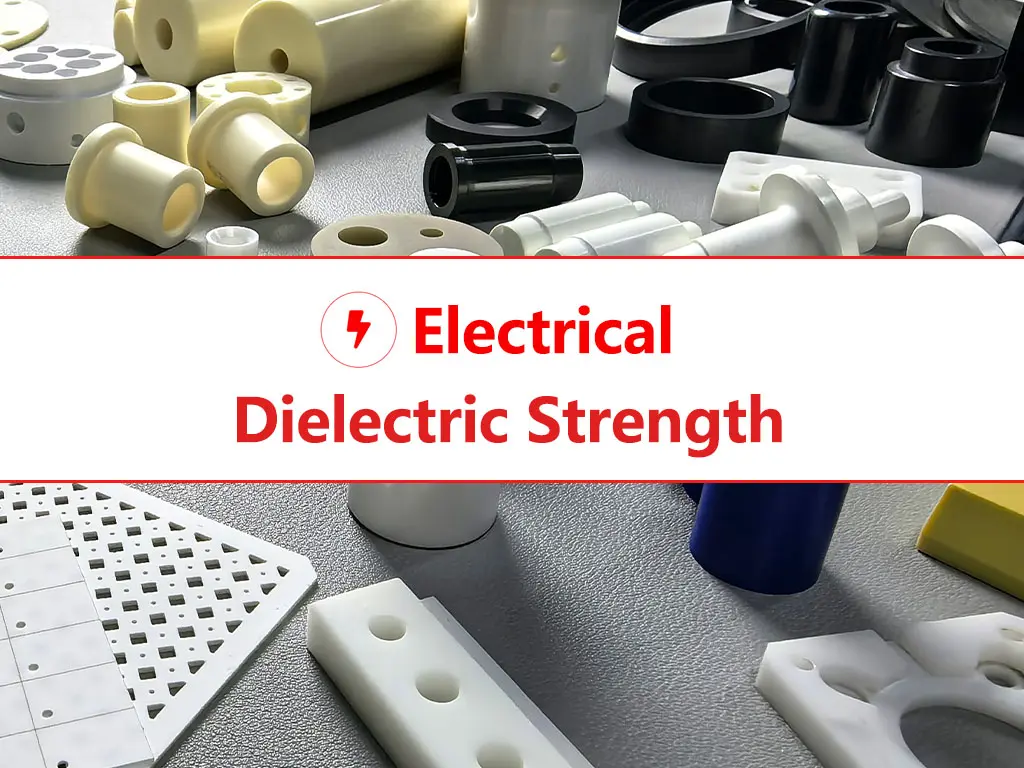
Dielectric strength, also known as breakdown voltage, is the maximum electric field strength that a material can withstand before it conducts electricity. It is measured in kV/mm (or MV/m) and is critical to ensuring the reliability of insulators in electronic, high voltage and thermal applications. This paper explores the dielectric properties of the major ceramic materials, plastics and insulating grade materials and provides a visual comparison and insight into their importance.
dielectric strength

What is dielectric strength?

Dielectric strength indicates the maximum electric field that a material can withstand without electrical breakdown. In solids, breakdown occurs when enough energy ionizes the structure and allows current to flow. High dielectric strength is critical to prevent arcing and ensure equipment safety and longevity.

Ceramics generally outperform plastics and glass, with a dielectric strength of 10-40 kV/mm compared to 1-3 kV/mm for plastics.

Safety Precautions: Ceramics can handle electric fields better, but must be selected for thermal and mechanical compatibility.

Why is it a core indicator?

Key Insights

  • Ensure insulation safety

    In high-voltage, high-frequency and vacuum environments, inadequate dielectric strength can lead to breakdown or arc discharge.

  • Extended product life

    High dielectric strength ceramics can withstand larger voltage loads without increasing component size.

  • Enhanced system reliability

    It is especially important in aerospace and medical systems, where minor dielectric failures can lead to system crashes and even safety hazards.

  • Ceramics with plastics and liquids:

    The dielectric strength of high-purity ceramics (Al₂O₃, AlN, h-BN, BeO) is in the range of 15-40 kV/mm, which is comparable or superior to that of plastics, and much higher than that of transformer oil or liquids such as air.

  • Material differences:

    • The breakdown strength of h-BN ceramics is about 40 kV/mm.
    • AlN and Al₂O₃ are commonly used as insulating substrates.
    • Although silicon carbide is hard, it has a significantly lower dielectric strength and is not suitable for use as a high-voltage insulating material.
  • The anisotropy problem:

    • h-BN exhibits orientation-dependent breakdown: up to 12 MV/cm parallel to the c-axis.

Dielectric strength of ceramic materials

Ceramic materials Dielectric strength (kV/mm) hallmark
Beryllium oxide (BeO) ~27 kV/mm Excellent thermal conductivity and high dielectric strength; used in high power electronic devices.
Aluminum Nitride (AlN) ~20 kV/mm High thermal conductivity and excellent electrical insulation; suitable for microelectronics.
ZTA 20% 80 - 120 kV/mm Zirconia toughened alumina with enhanced fracture toughness and moderate dielectric properties.
Silicon Nitride (Si3N4) ~15 kV/mm High mechanical strength and good thermal shock resistance for use in demanding environments.
Boron Nitride (BN) 40 kV/mm Excellent thermal stability and electrical insulation; commonly used in RF and vacuum applications.
Machinable Glass Ceramics (MGC) ~15 kV/mm Easy to machine while maintaining electrical insulation; suitable for prototyping and customized shapes.
Silicon Carbide (SiC) 2-10 kV/mm High hardness and high thermal conductivity, but limited dielectric strength; used in high temperature applications.
Aluminum oxide (Al2O3, 96-99.7%) 17 kV/mm Widely used technical ceramics with balanced mechanical, thermal and electrical properties.
Zirconium oxide (ZrO2) ~9 kV/mm High strength and fracture toughness; lower dielectric strength, but used where toughness is critical.

*Data is for reference only.

* Typically, dielectric properties decrease significantly with increasing temperature.

Need help choosing the right ceramic?

Choosing the right high-strength ceramic material is critical to ensuring long-term reliability and optimal performance. Whether you need zirconia, silicon nitride, or alumina-based ceramics, our materials provide industry-leading strength, durability, and precision.

Our technical team is here to help - contact us today for expert customized advice on your specific needs.

Comparison of dielectric strength

Below is a bar graph comparing the dielectric strength of advanced ceramics with plastic and common insulators.

Ceramic
Plastic
Insulation Fluid/Air

*Data is for reference only.

Applications based on ceramic dielectric strength

  • Material: Aluminum oxide (Al₂O₃), dielectric strength: 10-15 kV/mm
  • Applications: high voltage vacuum circuit breakers, substation insulators, insulating rings
  • Case Study: 99.5% pure alumina insulators operated reliably between -40°C and 250°C without dielectric breakdown in a 500kV UHV transmission project.
  • Advantages: high dielectric strength, good thermal stability, excellent aging resistance
  • Material: Aluminum Nitride (AlN), Dielectric Strength: 12-15 kV/mm, Thermal Conductivity: 170-200 W/m-K
  • Applications: RF modules, power semiconductor packaging, 5G communication equipment
  • Case Study: AlN substrate replaces alumina in 5G base station power amplifiers, significantly enhancing heat dissipation and dielectric reliability to support stable RF output up to 120W.
  • Advantages: high dielectric strength, low high frequency dielectric constant, high thermal conductivity
  • Material: stabilized zirconia (ZrO₂), dielectric strength: 8-12 kV/mm
  • Applications: X-ray tube housings, detector isolation structures in CT scanners
  • Case Study: High-end CT systems use zirconia ceramic housings as X-ray tubes, eliminating the arc discharge problem of metal housings and improving image stability and longevity.
  • Advantages: excellent electrical insulation properties, high mechanical strength, high processing precision
  • Material: Silicon Nitride (Si₃N₄) or Silicon Carbide (SiC); Dielectric strength: ~15 kV/mm and 20-30 kV/mm, respectively
  • Application: Microwave Waveguide Insulation in Aerospace Communication Systems
  • Case study: Microwave waveguides for earth stations use hot-pressed silicon carbide ceramics as an insulating structure to prevent signal loss due to electric field breakdown.
  • Advantages: high dielectric strength, resistance to thermal shock, resistance to plasma corrosion
  • Material: Machinable glass-ceramic (MGC)
  • Applications: electrostatic capacitor housings, capacitive sensor bases
  • Case Study: In aerospace electrical systems, miniature capacitors using MGCs as insulating cases withstand high voltages when operating at temperatures from -200°C to 800°C.
  • Advantages: very high dielectric strength, easy processing, ultra-low thermal expansion

Related High Dielectric Strength Ceramics

Frequently Asked Questions (FAQ)

Boron Nitride (h-BN) with voltages up to 40 kV/mm, comparable to or exceeding high-performance plastics or insulating fluids.

Prevents insulation breakdowns and short circuits. The higher the strength, the less insulation thickness is required, resulting in space and cost savings.

SiC has semiconducting properties at high fields and is not suitable for purely insulating applications despite its mechanical strength.

Thickness, impurities, temperature, humidity and electrode geometry affect the actual breakdown value.